Recent news 2026

February 01, 2026
About oversized eyeballs and why I can finally see much better again...
A few months ago, the natural lenses in my eyes were replaced with artificial ones due to rapidly progressing cataracts. This is the most commonly performed surgery in Belgium each year and is practically a standard procedure for the elderly, as cataracts are a classic age-related disease. But I'm anything but elderly, and in my case, it wasn't a matter of a fifteen-minute operation performed by any ophthalmologist under local anesthesia; quite the opposite... And I'd like to share this story because I've been through a rather bizarre period.
I've been wearing glasses since I was 7 or 8 because I'm nearsighted, and for a long time, it worked fine. As the years went by, my vision gradually deteriorated, and my lenses became thicker and thicker. It gradually stabilized, then remaining stable for years at a diopter of -8.25 (the prescription of the required lenses). But two years ago, my vision suddenly deteriorated dramatically. It was discovered that both my lenses had developed cataracts, and my glasses went up to -9.25 diopters. A year later, the cataracts worsened significantly, and my glasses went up to -13.00 diopters. Further testing revealed that even higher diopters brought no improvement.
The only remaining option was to replace both cataract-affected lenses with artificial ones, which would immediately resolve all problems. This is called phacoemulsification (dissolving the lens) and RLE (Refractive Lens Exchange), making it one of the most commonly performed eye surgeries.
But my eyeballs weren't exactly as expected, as it had long been known that they were too large. A laser scan revealed that they were now more than 5 mm larger and longer than normal (28 mm instead of 23 mm). My ophthalmologist said this was quite unusual and that replacing the lenses wasn't possible without first performing a vitrectomy (removal of the vitreous humor from the eyeball). She also said that due to my excessively large eyeballs and my relatively young age, it was a risky operation because the vitreous humor hasn't yet naturally detached from the retina (which generally happens in older people), posing a relatively high risk of a retinal tear or partial or complete retinal detachment, potentially resulting in blindness. Ultimately, in November 2024, the ophthalmologist referred me to Prof. Stalmans of the University Hospital Leuven because he was one of the few eye surgeons in Belgium specializing in this area.
It wasn't until July 2025 that I was able to see Prof. Stalmans for the first time, and two months later, after numerous examinations at the University Hospital Leuven, the final appointments for the two surgeries were made. Remarkably, the cataract had worsened (and consequently, the eye lenses had become even darker, tougher, and thicker), so that the final laser measurement showed a diopter that had increased from -13.00 to a whopping -21.00. The decision was ultimately made to implant artificial lenses, which would bring the final diopter to -3.00 instead of 0.00 (= no glasses) for both eyes, because I wanted to continue wearing glasses (I've been wearing them for over 50 years, and wearing glasses also has advantages because spectacle lenses protect your eyes, and therefore also the artificial lenses, from wind, sand, UV radiation, etc.). It turns out to be very difficult to achieve an exact 0.00 diopter with artificial lenses, because everything depends on how the artificial lens ultimately nestles in the lens pouch, which means there is a good chance that you will ultimately need slightly corrective glasses with a diopter of 0.25 or -0.25 or or even stronger.
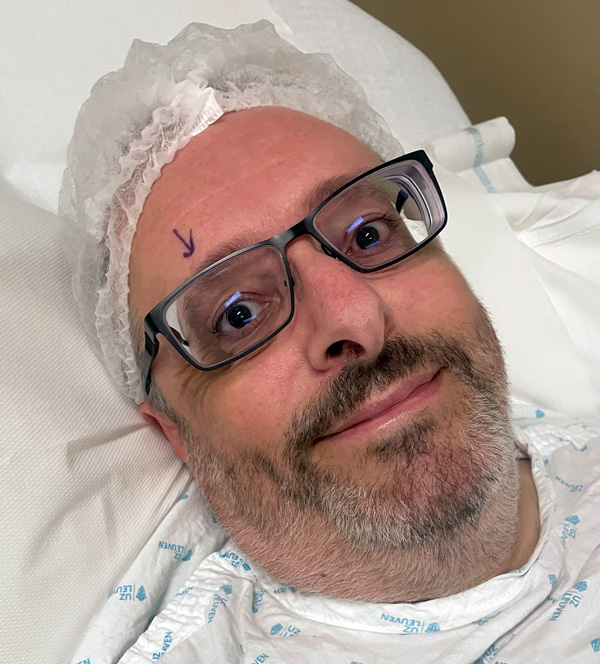
The last time I wore glasses with a diopter of -13.00, notice how narrow my head looks through the lenses...
And guess which eye was operated on first?
Both surgeries were performed under general anesthesia on October 10th and 13th, 2025, and each lasted about an hour and a half, with a two-day hospital stay. Normally, surgeries on both eyes are separated by two weeks, but in my case, there was only a weekend between them because it would have been far too taxing on the brain to have to walk around with one eye corrected with a diopter of -3.00 and the other with a diopter of -21.00 for two weeks.
The first surgery on my right eye went perfectly, but the second surgery on my left eye involved complications, and a retinal tear did indeed occur during the vitrectomy. The right eye healed quickly and well, while the left eye still hasn't fully healed to this day, but my vision is very good in both eyes. I also now have my permanent new multifocal glasses with a diopter of -3.25 on my right and -3.00 on my left, so it was also difficult to achieve a perfect -3.00. The last time I had such a low diopter was at least 45 years ago, and I expect it will remain that way for the rest of my life.
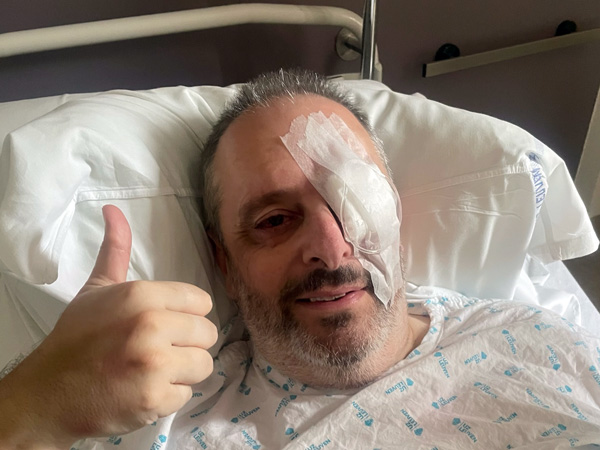
The second surgery is over and I'm just back in the room, but I didn't know yet that there had been complications...
And a very rare one: my hand without my faithful silver rings...
Some more fun and sometimes quite bizarre experiences and facts:
- My right eye was filled with aqueous humor (= plain water) allowing me to see clearly again immediately.
- My left eye was filled with air to hold a gel in place that fixed the torn retina, which left me with little to no vision for a long time. You can't see through air in the eye because air isn't an intermediate optical medium like the aqueous humor in the right eye or the vitreous humor naturally present in the eye.
- The first test for my left eye the day after surgery was the 'VT test,' and the result was 'VT 0.5m,' which literally means "Finger Test 0.5 meters." In other words, I could only see the difference between one or two raised fingers at a distance of no more than half a meter.
- The air in the left eye was automatically replaced by newly produced vitreous humor, so I literally saw my eye fill up with vitreous humor again over a period of 6 to 8 weeks.
- But the bizarre thing is that your retina 'sees' everything upside down because the lens projects the image from outside onto your retina upside down (just like in a camera). In reality, the eye started filling with vitreous humor at the bottom, but you see it filling from the top. The vitreous, while still very dirty, is transparent, so over time you can see above the air bubble while actually looking below it.
- Once the separation between the air and the vitreous is roughly in the middle of your eye, when you move your head from side to side, you literally have a perfect level in your eye, and for several weeks I saw everything that was crooked everywhere. And that's a bit of a shock, because then you see all the things that aren't perfectly level in the world, from frames, paintings, and screens on the wall, to traffic and billboards on the street, to gutters, walls, and even roof ridges. You can't "not see" this, so it's quite a thing...
- When the eye is almost full, there's something left at the bottom that looks like a small, dirty puddle (very similar to the remains of red wine in a wine glass) that you can slosh around quite nicely, while in reality you're looking up at the remnants of air still on top of the vitreous, with dirt (including red blood cells) floating on top of it.
- This puddle then gets smaller and smaller until it becomes a black droplet, then an air bubble with a black edge, a black dot, a tiny white air bubble, until it finally disappears completely.
- And I haven't even mentioned the graceful patterns that all the dirt in the vitreous creates. At first, it was as if someone with a black If you write felt-tip pen letters in your eye, they become zigzagging curtains of hundreds of black dots, then strings of black dots that become increasingly finer until the vitreous is finally almost perfectly clear again.
- A human being has a primary eye and a secondary eye (comparable to being right-handed or left-handed). My primary eye is the left eye, so when I couldn't see well with that eye, my brain temporarily became the primary eye. Over time, however, I could see better and better with my left eye, and one evening I was watching TV when my brain suddenly switched back to the left eye as the primary eye. This was a very special experience, a very blissful and satisfying feeling, comparable to coming home after a long journey because suddenly the world looked as it always had. And it was very clear proof that it is the brain that "sees," not the eyes themselves, because the only thing eyes do is convert light into nerve impulses, which the brain then interprets into the image you literally only see in your mind. So suddenly, the brain had received enough information from the left eye to reassemble the old, familiar image, very bizarre...
- Oh yes, I've also received the final bill in the meantime. The surgeries together cost over €15,000, of which only €348.48 was for the two artificial lenses themselves, including fixed costs (one lens itself costs only €74.37)... But of course, I have good hospital insurance, so in the end it cost me practically nothing.
In retrospect, I might have been better off with a 0.00 diopter because, despite the fact that those artificial lenses are very good, there's one thing they can't do compared to your natural lenses: automatically focusing. As a result, multifocal glasses for both near and far vision are less fluid than they used to be. But there's still the option of getting two pairs of monofocal glasses: one for distance vision and a pair of computer glasses for near vision. But before that, I'll wait a little longer until my brain has completely gotten used to the multifocal lenses.
In short, it was quite an adventure for me (not to mention the potential risk of losing sight in one or both eyes), on the one hand with a lot of discomfort, but on the other hand also with strange visual effects in my left eye and in my brain due to the excruciatingly slow refilling of the left eye with vitreous fluid, effects you probably only experience once in a lifetime...
And now I can finally see everything clearly on the studio screens again, read the small print under the buttons on the synthesizers, and even the microwave manual. This is a definitive result, and I can only be very happy with it. Exclamation point!
Happy new year!

Copyright © 1995-2026 by Delta Music Belgium • Dolby Atmos Music Studio • Rummenweg 30 • 3800 Sint-Truiden • Belgium
All Rights Reserved
Privacy notification and cookie policy
All product names, logos, and brands are property of their respective owners.
All company, product and service names used on this website are for identification purposes only.
Use of these names, logos, and brands does not imply endorsement.